---
title: It’s not about creating shade, it’s about understanding light
description: In roses and gerberas, managing light goes beyond creating shade. Learn how radiation, temperature, humidity, and diffuse light influence the greenhouse climate and the quality of flowers grown in warm regions.
image: https://knowledge.ludvigsvensson.com/hubfs/Banner_June_blog_2026%20opc%202.png
---
- [Svensson Group](https://www.ludvigsvensson.com/en-gb)
- [Climate Screens](https://www.ludvigsvensson.com/en-us/climate-screens)
- [INTERIOR TEXTILES](https://www.ludvigsvensson.com/en/interior-textiles)
[](https://www.ludvigsvensson.com/en-us/climate-screens)
[](https://www.ludvigsvensson.com/en/checkout/)
Menu
-
- [Products](https://www.ludvigsvensson.com/en-us/climate-screens/product-portfolio)
- [Grower stories](https://www.ludvigsvensson.com/en-us/climate-screens/grower-stories)
- Insights
- [Crop tips](https://www.ludvigsvensson.com/en-us/climate-screens/crop-cultivation-tips)
- [Climate challenges](https://www.ludvigsvensson.com/en-us/climate-screens/climate-challenges)
- [Maintenance](https://www.ludvigsvensson.com/en-us/climate-screens/installation-maintenance/climate-screens-maintenance)
- Installation
- [Highlights](https://www.ludvigsvensson.com/en-us/climate-screens/highlights)
- [Contacts](https://www.ludvigsvensson.com/en-us/climate-screens/contact)
*Expand Search*
en
- [English](https://www.ludvigsvensson.com/en/climate-screens/)
- [Deutsch](https://www.ludvigsvensson.com/de/climate-screens/)
- [Nederlands](https://www.ludvigsvensson.com/nl/climate-screens/)
- [한국어](https://www.ludvigsvensson.com/ko/환경제어-스크린/)
- [中文](https://www.ludvigsvensson.com/cn/气候调节幕布/)
- [Русский](https://www.ludvigsvensson.com/ru/climate-screens/)
- [Español](https://www.ludvigsvensson.com/es/pantallas-climaticas/)
[](https://www.ludvigsvensson.com/en/checkout/)
Menu
-
1. [Warmzones Growers' Blog](https://knowledge.ludvigsvensson.com/en/warmzones)
2. It’s not about creating shade, it’s about understanding light

[Warmzones Growers' Blog](https://knowledge.ludvigsvensson.com/en/warmzones) / [Climate Control](https://knowledge.ludvigsvensson.com/en/warmzones/tag/climate-control) / [Light Control](https://knowledge.ludvigsvensson.com/en/warmzones/tag/light-control) / [Temperature](https://knowledge.ludvigsvensson.com/en/warmzones/tag/temperature) / [Climate screens](https://knowledge.ludvigsvensson.com/en/warmzones/tag/climate-screens) / [Flowers](https://knowledge.ludvigsvensson.com/en/warmzones/tag/flowers) / [PARperfect](https://knowledge.ludvigsvensson.com/en/warmzones/tag/parperfect) / [Roses](https://knowledge.ludvigsvensson.com/en/warmzones/tag/roses) / [Radiation](https://knowledge.ludvigsvensson.com/en/warmzones/tag/radiation) / [Gerberas](https://knowledge.ludvigsvensson.com/en/warmzones/tag/gerberas)
# It’s not about creating shade, it’s about understanding light
6 minutes
[**Martha Alape**](https://knowledge.ludvigsvensson.com/en/warmzones/author/martha-alape)
29 June 2026
*In roses and gerberas, managing light as part of the greenhouse climate strategy can help create more stable conditions for flower quality.*
*When I work with rose and gerbera growers in Colombia, one question comes up very often: how can we give the crop enough light without that same light creating conditions that are difficult to manage inside the greenhouse?*
In flowers, light is essential. Without light, there is no photosynthesis, no proper plant development, and no flowering with the quality that the most demanding markets expect. But in areas with intense radiation and high temperatures, the challenge is not always to receive more light. Many times, the real challenge is to better manage the way that light enters, is distributed, and interacts with temperature, humidity, and ventilation.
That is why, when we talk about shading in flower crops, I like to go one step further. It is not only about “covering” the sun. It is about understanding light as part of a climate strategy.
**Light influences much more than just growth**
In roses and gerberas, light plays a role in the development of leaves and stems, and supports important processes related to flowering. But light also influences aspects that are very concrete for growers, such as uniformity, flower size, stem length, color, firmness, and vase life. Not because light alone determines everything, but because it influences the internal climate that supports the plant’s development every day.
In roses, for example, intense radiation combined with temperature changes can influence petal quality. In some cases, problems such as blackening, or darkening of the petals, have been associated with several factors, including variety sensitivity, radiation, UV exposure, and temperature changes between day and night. There is no single clear cause for every case, but it is a topic that growers pay close attention to when working in areas with high radiation.
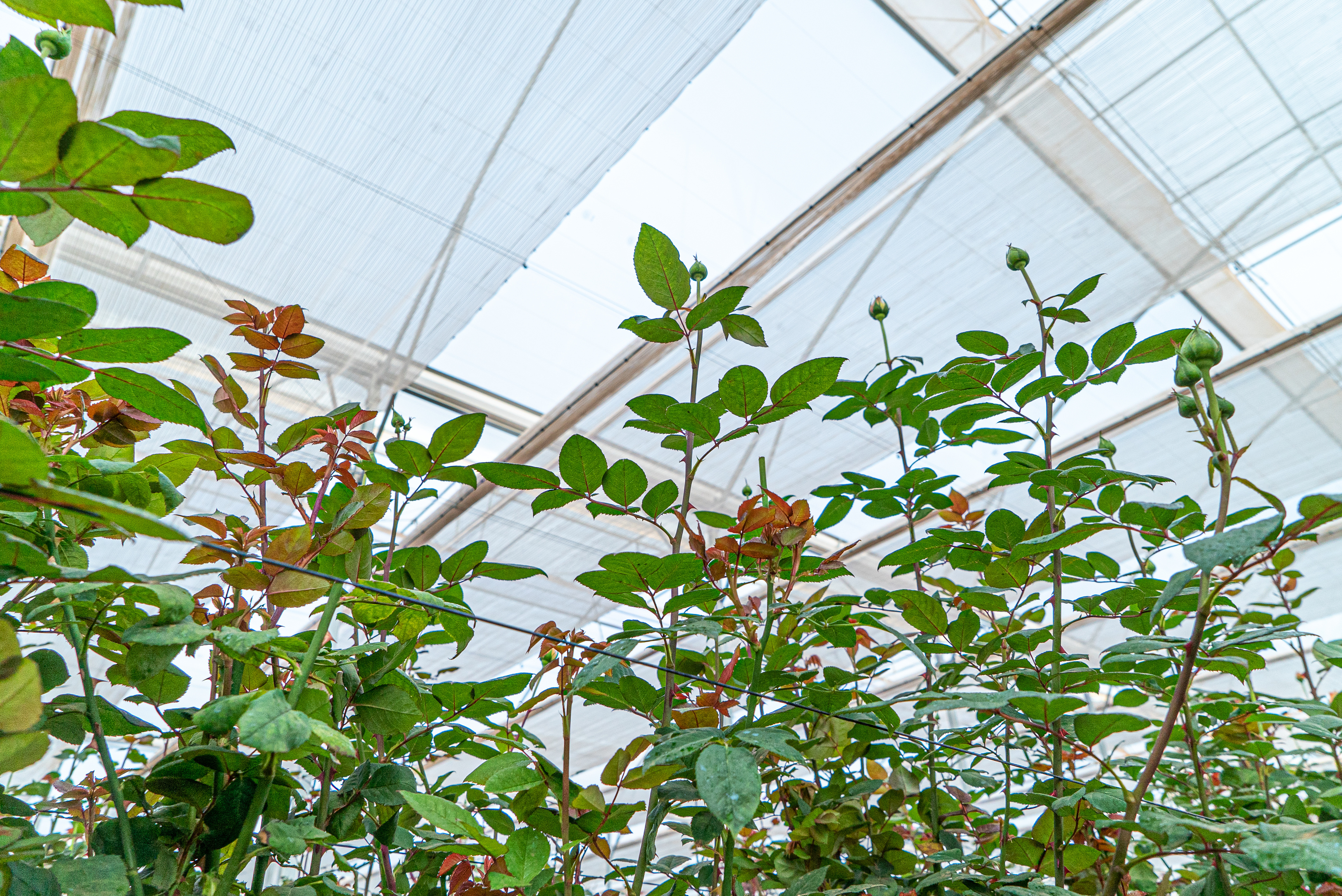
In gerberas, the conversation is usually different. The structure of the plant makes light distribution very important. It is not enough to think about how much light enters the greenhouse; it also matters whether that light reaches the plant evenly and whether it helps maintain more stable conditions around the crown, leaves, and flower.
**In warm regions, high radiation can make the climate harder to manage**
In many warm regions, when radiation enters with too much intensity, it can raise the temperature inside the greenhouse and on the plant surfaces. This can affect transpiration, relative humidity, and the way the crop responds throughout the day.
In practice, this translates into daily decisions such as when to ventilate, when to open or close a screen, how to avoid heat peaks, how to prevent plant stress, and how to help the crop behave more uniformly.
That is why talking about shade should not start with a question like, “What percentage do I need?” For me, it should start with questions such as:
- What crop am I growing?
- What level of radiation do I have during the day?
- How does the temperature change inside the greenhouse?
- What happens with humidity?
- Where are the hottest or most irregular areas?
- What commercial quality do I need to deliver?
The answers to these questions help build a strategy, not just choose a product.
**Shade does not mean taking light away**
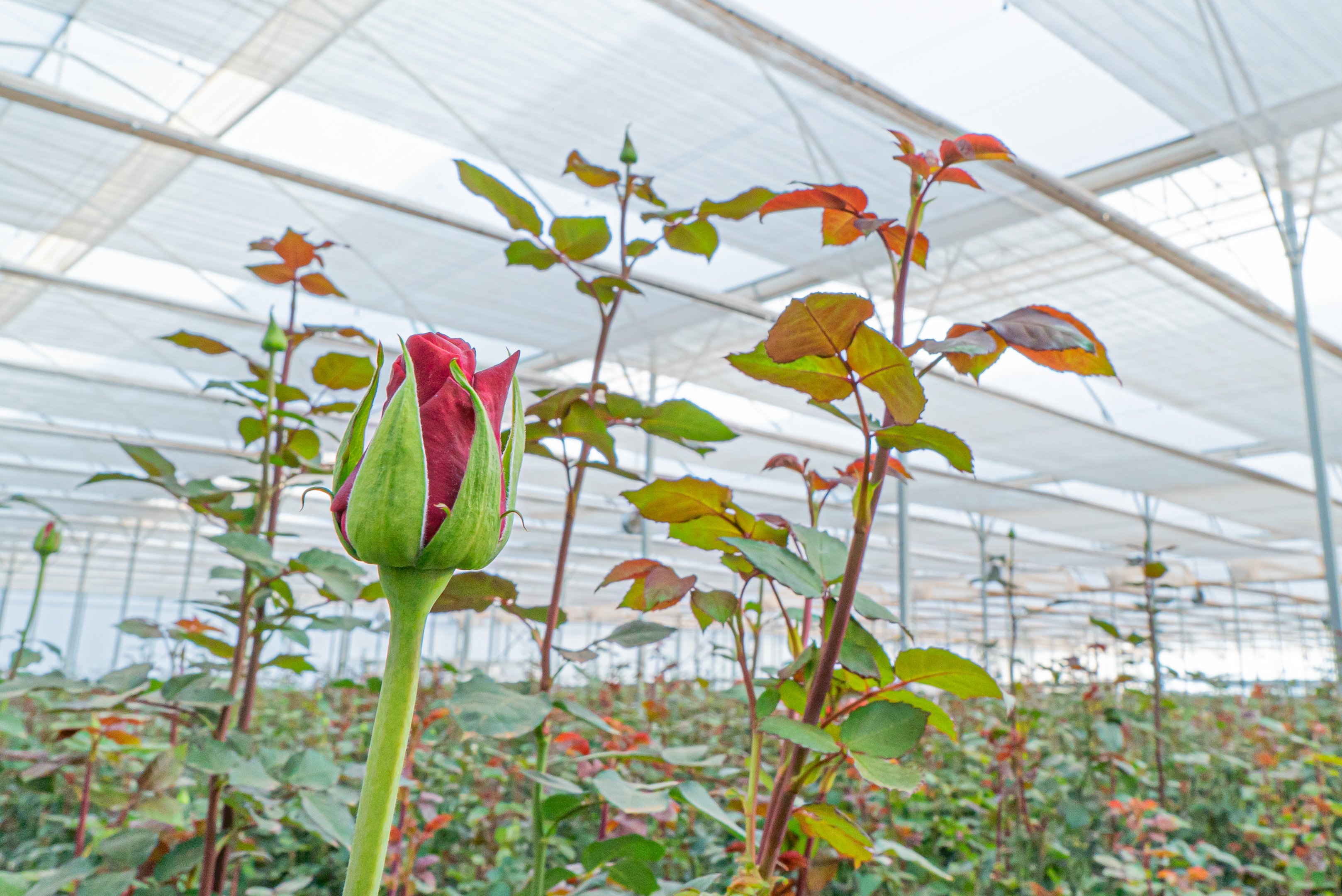
One of the most common mistakes is thinking that shading simply means reducing light. In flowers, this can be especially delicate, because the plant needs light to maintain its activity.
The idea is not to leave the crop without energy. The idea is to manage the intensity of radiation so the plant can make better use of the available light, without excess heat or strong variations in the internal climate affecting its development.
This is where an important concept comes in: diffuse light.
Direct light reaches the crop from a more defined direction. It can create areas with higher intensity, stronger shadows, and differences within the crop. Diffuse light, on the other hand, is distributed more evenly. This can help light reach more parts of the plant, not only the upper or more exposed areas.
In crops such as roses and gerberas, this difference matters. A more uniform light distribution can support more even development and help reduce differences inside the greenhouse.
Another concept that comes up often when we talk about light is PAR, which stands for photosynthetically active radiation. Put simply, it is the part of light that the plant can use for photosynthesis.
When we analyze light in a greenhouse, we are not only interested in how much radiation enters. We are also interested in what type of light is available to the plant and how that light is distributed. In flowers, this balance is very important because we need to protect the crop from extreme conditions, while maintaining enough useful light to support development and quality.
**Roses and gerberas do not respond the same way**
Although roses and gerberas share some challenges, we cannot manage them as if they were the same crop.
In roses, light management is often closely connected to the visual quality of the flower. We talk about color, bud size, stem length, firmness, uniformity, and vase life. [In a previous article about blackening in rose petals](https://knowledge.ludvigsvensson.com/en/warmzones/why-rose-petal-blackening-is-becoming-a-strategic-question-for-growers?hsLang=en), I shared how some growers have observed this issue under conditions of high radiation, UV exposure, and significant temperature changes. I also mentioned the case of a grower in Cayambe, Ecuador, who installed a Harmony 2047 FR screen and observed less blackening, more intense petal color, and improvements in stem length and leaf characteristics.
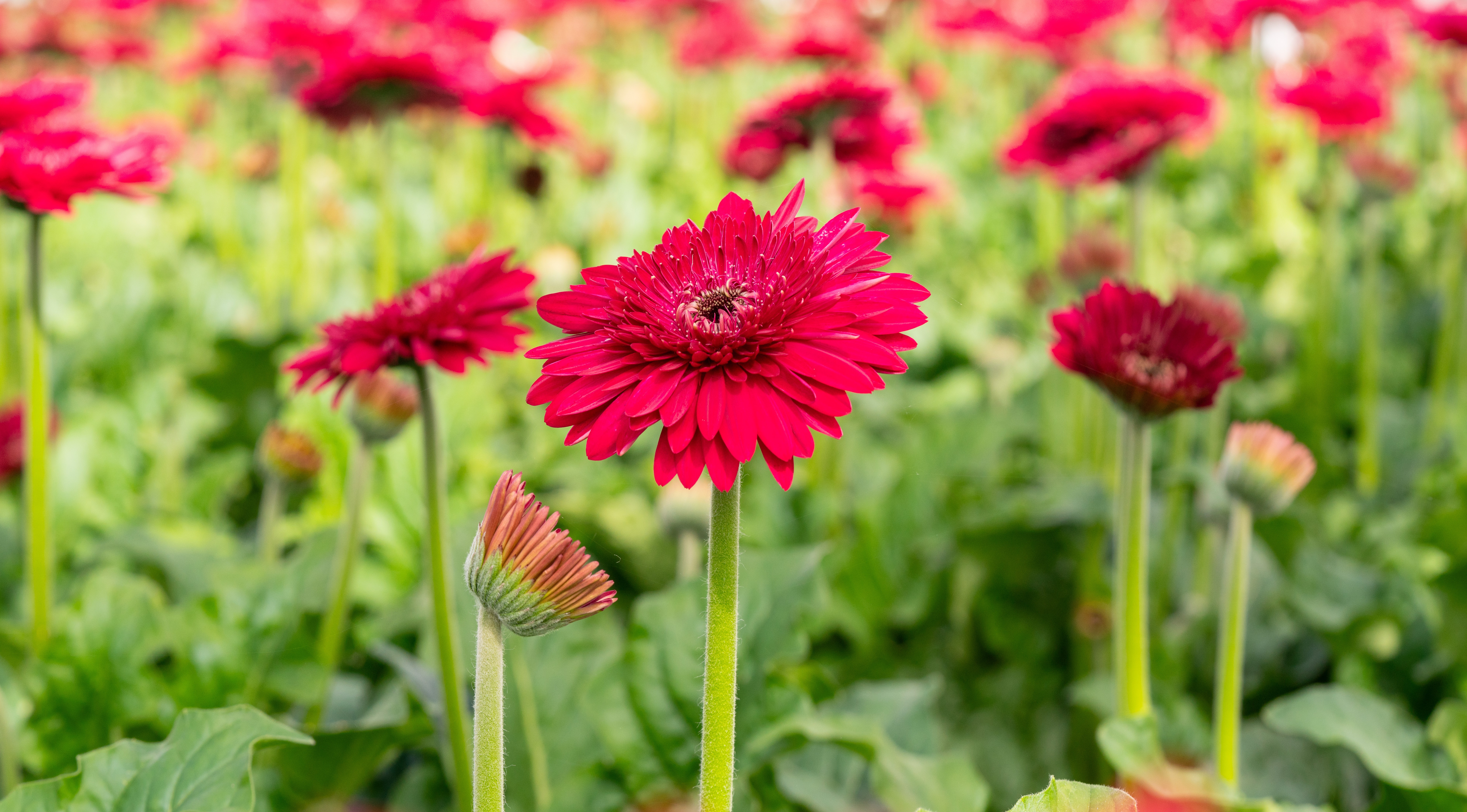
In gerberas, the conversation may focus more on light distribution around the plant and on how to protect sensitive structures without limiting crop activity. Gerberas need light, but they also require conditions that do not create unnecessary stress. When radiation is very intense, shade management and diffuse light can help create a more stable environment for flower development.
In both cases, the decision should start with the crop, the variety, the greenhouse structure, the season, and the commercial objective.
**Understanding light to make better climate decisions**
Climate screens can be an important tool to manage radiation entering the greenhouse, light distribution, and the stability of the inside climate. But a screen does not work alone.
Its performance depends on the greenhouse structure, ventilation, crop, season, location, daily management, and the grower’s objectives. That is why a climate screen is not an isolated product; it should be considered as part of the grower’s climate strategy.
Products like [Harmony](https://www.ludvigsvensson.com/en-us/climate-technologies/products/harmony) can be part of this conversation when the goal is to better manage the available light, encourage more uniform distribution, and support more stable conditions inside the greenhouse.
There are also dual screen technologies, such as [PARperfect](https://www.ludvigsvensson.com/en-us/climate-technologies/product-portfolio/parperfect), that help bring a very important question to the table: how can we achieve a better balance between light transmission, diffusion, and crop protection? This conversation is especially relevant in warm regions, where growers need to protect quality without losing sight of plant activity.
The important thing to remember is that there is no single answer for everyone. A strategy that works for roses in an area with high radiation may not be the same one needed for gerberas in a different structure or during another season.
In my experience, when a grower starts observing light in more detail, the grower also begins to better understand the internal climate. The grower starts to see where the greenhouse heats up the most, where the crop responds differently, where humidity behaves in another way, where flowering is less uniform, and where quality changes from one bed to another.
That observation is the first step toward making better climate decisions and helps answer a key question: what conditions does my crop need to perform better inside this greenhouse?
And that answer almost never comes from a recipe. It comes from observing, measuring, having conversations, and working side by side with growers to create conditions that truly work.
*Martha Alape, Climate Consultant at Svensson, working alongside rose growers in Mexico*
- [](https://cta-service-cms2.hubspot.com/web-interactives/public/v1/track/redirect?encryptedPayload=AVxigLJ37dsUNXsEoJctn3unHt%2B78UAOrbbhvRGEWhzZwvDARXFglTB%2BfVkD1HmC4wakjDvdnCJXjVqheu25ocgJBFesGDr7N4XDHVCnDahB802gYJF2IzbQUJH3%2FMi4rV7bO6QUpuADAYD0106ZYyhjYom5IA%3D%3D&webInteractiveContentId=152441460051&portalId=7329237)
-
-
- [mailto:?subject=https://knowledge.ludvigsvensson.com/en/warmzones/its-not-about-creating-shade-its-about-understanding-light](mailto:?subject=https://knowledge.ludvigsvensson.com/en/warmzones/its-not-about-creating-shade-its-about-understanding-light)
### Related articles
[](https://knowledge.ludvigsvensson.com/en/warmzones/growing-120-crops-year-round-in-a-high-tech-hot-oasis-on-cairo-alex-desert-road?hsLang=en)
Climate screens / [Light Control](https://knowledge.ludvigsvensson.com/en/warmzones/tag/light-control), [Temperature](https://knowledge.ludvigsvensson.com/en/warmzones/tag/temperature), [Insect nets](https://knowledge.ludvigsvensson.com/en/warmzones/tag/insect-nets), [Climate screens](https://knowledge.ludvigsvensson.com/en/warmzones/tag/climate-screens)
## [Growing 120 crops in a high-tech oasis on the Cairo Alex Desert Road](https://knowledge.ludvigsvensson.com/en/warmzones/growing-120-crops-year-round-in-a-high-tech-hot-oasis-on-cairo-alex-desert-road?hsLang=en)
Imagine a place where in summer a plastic greenhouse without climate control will reach 70 °C in just one hour.
[Read more](https://knowledge.ludvigsvensson.com/en/warmzones/growing-120-crops-year-round-in-a-high-tech-hot-oasis-on-cairo-alex-desert-road?hsLang=en)
/EMEA/NL/Hugo%20-%20Meet%20the%20expert.png)
**Hugo Plaisier**
26 June 2024
Read time: 8 minutes
[](https://knowledge.ludvigsvensson.com/en/warmzones/why-a-perfect-spring-can-threaten-the-success-of-your-newly-planted-crop?hsLang=en)
Climate screens / [Humidity Control](https://knowledge.ludvigsvensson.com/en/warmzones/tag/humidity-control), [Climate Control](https://knowledge.ludvigsvensson.com/en/warmzones/tag/climate-control), [Light Control](https://knowledge.ludvigsvensson.com/en/warmzones/tag/light-control), [Humidity](https://knowledge.ludvigsvensson.com/en/warmzones/tag/humidity)
## [Why a perfect spring can threaten the success of your newly planted crop](https://knowledge.ludvigsvensson.com/en/warmzones/why-a-perfect-spring-can-threaten-the-success-of-your-newly-planted-crop?hsLang=en)
Mostly we associate humidity problems with the wetness of winter or the heavy moist heat of high summer, but there’s a particular risk to greenhouse..
[Read more](https://knowledge.ludvigsvensson.com/en/warmzones/why-a-perfect-spring-can-threaten-the-success-of-your-newly-planted-crop?hsLang=en)
/EMEA/NL/Hugo%20-%20Meet%20the%20expert.png)
**Hugo Plaisier**
08 April 2025
Read time: 3 minutes

Ludvig Svensson
**Headquartered in Sweden**
**with an expansive global presence**
[About Us](https://www.ludvigsvensson.com/en/about-us/)
[Work With Us](https://www.ludvigsvensson.com/en/work-with-us/)
[Ludvigson Invest](https://www.ludvigsoninvest.com/)
- [facebook](https://www.facebook.com/SvenssonClimateScreens/)
- [linkedin](https://www.linkedin.com/showcase/svensson-climate-screens)
- [youtube](https://www.youtube.com/channel/UCAwK7gRWYnrmokIp7SlxEqA)
- #### **Climate Technologies**
- [People](https://www.ludvigsvensson.com/en-us/climate-screens/people)
- [Know-how](https://www.ludvigsvensson.com/en-us/climate-screens/know-how)
- [Grower stories](https://www.ludvigsvensson.com/en-us/climate-screens/grower-stories)
- [Products](https://www.ludvigsvensson.com/en-us/climate-screens/product-portfolio)
- [Contact](https://www.ludvigsvensson.com/en-us/climate-screens/contact)
```json
{
"@context" : "https://schema.org",
"@type" : "BlogPosting",
"author" : {
"@type" : "Person",
"name" : "Martha Alape",
"url" : "https://knowledge.ludvigsvensson.com/en/warmzones/author/martha-alape"
},
"dateModified" : "2026-06-29T16:04:10.523Z",
"datePublished" : "2026-06-29T16:04:10.000Z",
"headline" : "It’s not about creating shade, it’s about understanding light",
"image" : [ "https://knowledge.ludvigsvensson.com/hubfs/Banner_June_blog_2026%20opc%202.png" ],
"mainEntityOfPage" : {
"@id" : "https://knowledge.ludvigsvensson.com/en/warmzones/its-not-about-creating-shade-its-about-understanding-light",
"@type" : "WebPage"
},
"publisher" : {
"@type" : "Organization",
"logo" : {
"@type" : "ImageObject",
"url" : "https://knowledge.ludvigsvensson.com/hubfs/LOGO_SVENSSON_ORIGINAL_2014-1.png"
},
"name" : "Ludvig Svensson AB"
}
}
```